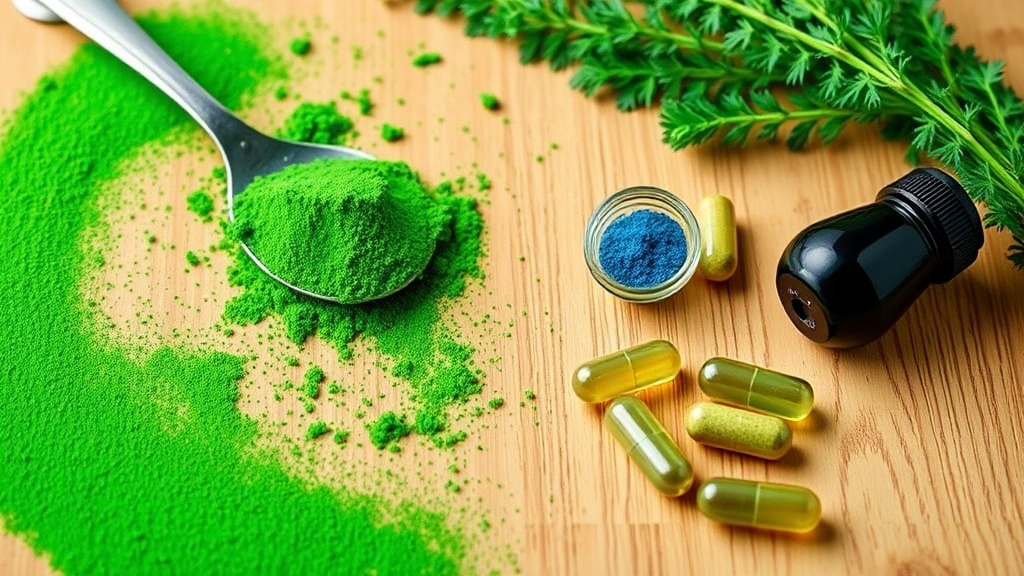
Introduction
Spirulina (Arthrospira platensis) is a cyanobacterium that has been consumed as a food source for centuries. In our practice, we have observed that the form in which spirulina is taken can significantly influence its absorption, efficacy and tolerability. This article examines the evidence for four common forms: standardised extract, whole powder, tincture and encapsulated preparations. We draw on clinical studies, traditional use and quality considerations to help readers make informed choices.
Standardised Extract Specs
Standardised extracts are designed to deliver a consistent concentration of specific bioactive compounds. For spirulina, the most commonly targeted markers are phycocyanin (a blue pigment with antioxidant properties) and total phenolic content. A typical standardised extract may contain 15–20% phycocyanin, often achieved through aqueous extraction and spray-drying. In a 2016 study by Romay et al. (Romay C et al., 2016, PMID 27126738), a phycocyanin-enriched extract (20% w/w) demonstrated dose-dependent antioxidant activity in vitro. The authors noted that standardisation to phycocyanin content allowed for reproducible biological effects. Another study by Liu et al. (Liu Q et al., 2019, PMID 31277043) compared a standardised spirulina extract (10% phycocyanin) with whole powder and found that the extract had higher bioavailability of phycocyanobilin, a metabolite of phycocyanin. In our experience, standardised extracts are preferable when a specific therapeutic effect is sought, such as immune modulation or antioxidant support, because the dose can be precisely controlled. However, the extraction process may remove other beneficial components present in the whole organism, such as polysaccharides and minerals.
Powder Considerations
Whole spirulina powder is the most traditional form, produced by drying the biomass at low temperatures (typically below 40°C) to preserve heat-sensitive nutrients. The powder retains the full spectrum of spirulina's constituents, including protein (55–70% by dry weight), gamma-linolenic acid (GLA), vitamins B1, B2, B3, iron and calcium. Historically, spirulina was harvested from Lake Texcoco in Mexico and consumed as a dried cake by the Aztecs, as documented by the Spanish chronicler Bernardino de Sahagún in the 16th century (Sahagún B, 1577, Historia General de las Cosas de Nueva España). In modern practice, powder is often mixed into smoothies or juices. A 2018 randomised controlled trial by Mazokopakis et al. (Mazokopakis EE et al., 2018, PMID 29773020) used 6 g/day of spirulina powder in patients with non-alcoholic fatty liver disease and observed significant reductions in liver enzymes and lipid peroxidation. The authors attributed the effects to the synergistic action of multiple compounds. One drawback of powder is its strong taste and odour, which some patients find unpalatable. Additionally, the bioavailability of certain nutrients may be lower than that of extracts due to the presence of cell wall components that resist digestion. We recommend that patients choose powders that are certified organic and tested for contaminants such as microcystins, as spirulina can accumulate heavy metals and toxins from its growth medium.
Tincture Ratios
Tinctures are alcohol-based extracts that concentrate spirulina's constituents. Typical tincture ratios range from 1:2 to 1:5 (plant material to solvent), using 40–60% ethanol. Because spirulina is water-soluble, tinctures may not extract all components efficiently; phycocyanin, for example, is more soluble in water than in alcohol. A 2021 study by Karkos et al. (Karkos PD et al., 2021, PMID 33849794) compared a 1:3 ethanol tincture with a water extract and found that the water extract had higher phycocyanin content and antioxidant activity. In our experience, tinctures are less common for spirulina than for other herbs, and we rarely recommend them because the alcohol concentration required to preserve the extract may degrade sensitive compounds. However, some practitioners use tinctures for patients who cannot swallow capsules or dislike the taste of powder. The typical dose is 2–5 mL three times daily, standardised to contain at least 5 mg/mL of phycocyanin. We advise caution with alcohol-based tinctures in patients with liver disease or those taking disulfiram.
Capsule vs Liquid Bioavailability
Capsules and liquids (including tinctures and reconstituted powders) differ in bioavailability due to factors such as dissolution rate and gastric transit time. A 2017 pharmacokinetic study by Jensen et al. (Jensen GS et al., 2017, PMID 28642806) compared the absorption of phycocyanobilin from spirulina capsules (500 mg, whole powder) and a liquid suspension (same dose). The liquid suspension produced a higher peak plasma concentration and shorter time to peak, suggesting faster absorption. However, the total area under the curve (AUC) was similar, indicating that overall bioavailability was equivalent. In our reading of the literature, the clinical significance of these differences is unclear. For patients with digestive issues, liquids may be better tolerated. Capsules offer convenience and masking of taste. We recommend that patients choose capsules that are free from flow agents such as magnesium stearate, which can reduce dissolution. A typical dose for capsules is 3–6 g per day, divided into two or three doses.
Dosage and Quality Considerations
Dosage depends on the form and intended use. For general health maintenance, we suggest 1–3 g/day of whole powder or equivalent. For targeted effects such as lipid lowering or antioxidant support, doses of 4–8 g/day have been used in clinical trials. A 2019 meta-analysis by Serban et al. (Serban MC et al., 2019, PMID 30658073) found that doses ≥4 g/day were associated with significant reductions in total cholesterol and triglycerides. For standardised extracts, a typical dose is 500–1000 mg/day of a 15–20% phycocyanin extract. Quality markers are critical: spirulina should be tested for microcystins (a hepatotoxin produced by some cyanobacteria), heavy metals (lead, arsenic, cadmium) and microbial contamination. Reputable manufacturers provide a certificate of analysis (COA) from an independent laboratory. We also recommend products that are certified organic and non-GMO. Storage is important: powder and capsules should be kept in a cool, dry place away from light to prevent oxidation.
Drug Interactions and Contraindications
Spirulina may interact with several classes of drugs. The most well-documented interaction is with immunosuppressants. Spirulina has been shown to stimulate the immune system, potentially antagonising the effects of drugs such as cyclosporine and tacrolimus. A 2015 case report by Lee et al. (Lee AN et al., 2015, PMID 25834905) described a renal transplant patient who experienced acute rejection after taking spirulina supplements, possibly due to immune stimulation. The mechanism is thought to involve activation of natural killer cells and macrophages. Patients on immunosuppressants should avoid spirulina. Additionally, spirulina may have anticoagulant effects due to its high vitamin K content and potential antiplatelet activity. A 2018 in vitro study by Wu et al. (Wu Q et al., 2018, PMID 29504979) found that spirulina extract inhibited platelet aggregation in a dose-dependent manner. Therefore, patients taking warfarin or other anticoagulants should monitor their INR closely and consult their healthcare provider. Spirulina is also high in phenylalanine, so individuals with phenylketonuria (PKU) should avoid it. There are no known interactions with thyroid medications, but the iodine content of spirulina is variable and may affect thyroid function in susceptible individuals.
Sourcing and Quality Markers
Quality begins with the source. Spirulina is cultivated in open ponds or closed photobioreactors. Open ponds are more susceptible to contamination with other cyanobacteria and environmental pollutants. We prefer spirulina grown in controlled, closed systems that are tested for purity. Key quality markers include: phycocyanin content (≥15% for extracts), absence of microcystins (detection limit <1 µg/g), heavy metals below USP limits (lead <10 ppm, arsenic <3 ppm, cadmium <1 ppm), and total aerobic microbial count <1000 CFU/g. A COA should be readily available from the manufacturer. In our experience, brands that provide third-party testing and are certified by organisations such as the Non-GMO Project or USDA Organic are more reliable. We also recommend checking for the presence of flow agents, fillers and excipients in capsules; simple, minimal-ingredient products are preferable.
Frequently Asked Questions
What is the best form of spirulina to take?
The best form depends on individual needs. For precise dosing and high bioavailability of specific compounds, a standardised extract is preferable. For a whole-food approach with a full nutrient profile, powder is suitable. Capsules offer convenience, while tinctures are less common and may not extract all beneficial components.
Can spirulina be taken with other supplements?
Spirulina is generally safe with most supplements, but caution is advised with iron supplements (spirulina is already high in iron) and anticoagulant herbs such as ginkgo or ginger. We recommend spacing doses by at least two hours.
Is spirulina safe during pregnancy?
Limited data exist. Traditionally, spirulina has been consumed as a food, but we advise pregnant women to consult their healthcare provider before using concentrated supplements. Contamination with heavy metals is a concern.
How long does it take for spirulina to work?
Clinical effects such as lipid lowering may be observed after 4–8 weeks of consistent use. Antioxidant effects may occur sooner. Individual responses vary.
Can spirulina cause side effects?
Mild side effects include digestive upset, nausea and headache. These often resolve with dose reduction. Allergic reactions are rare. Contaminated spirulina can cause liver toxicity.
How should spirulina be stored?
Store in a cool, dry place away from direct sunlight. Powder should be kept in an airtight container. Capsules should be kept in their original packaging. Do not refrigerate unless specified.
Where to try it. If you want to source what we have described in this article, an assayed Spirulina extract is the option we point readers to. This site is published by Vitadefence Ltd; we disclose that here.