Introduction
Spirulina (Arthrospira platensis) is a cyanobacterium that has been consumed for centuries, with documented use by the Aztecs and Kanembu people of Lake Chad. In our experience, dosing spirulina is not a one-size-fits-all matter; the form, extract ratio, and individual goal all influence the appropriate intake. This guide synthesises clinical data, traditional use, and quality markers to provide a practical framework for readers.
Powder vs Extract vs Tincture
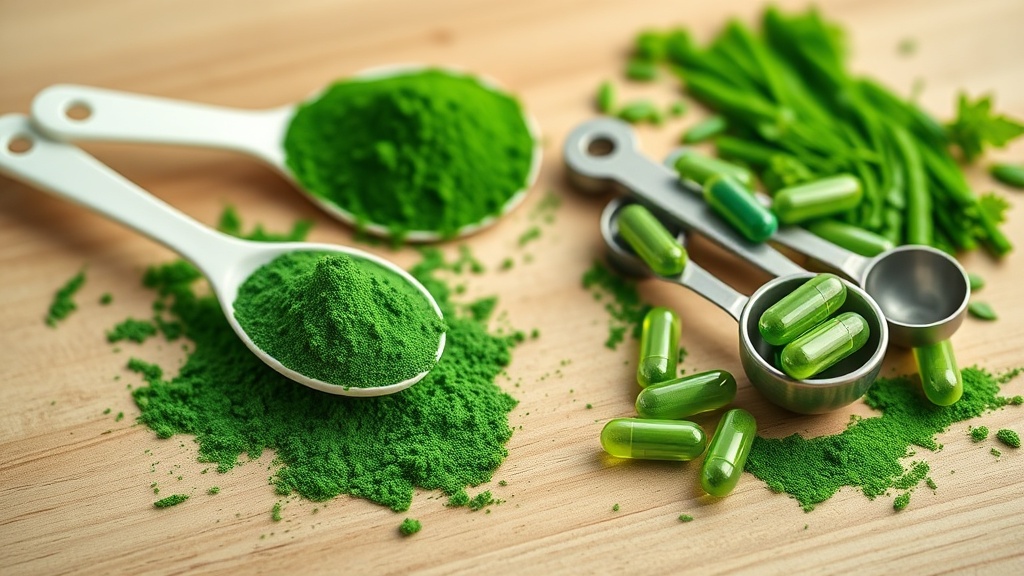
The most common form of spirulina is dried powder, typically sold as whole-herb (non-extracted) material. A standard dose of whole-herb spirulina powder in clinical trials ranges from 1 to 8 g per day, with 3 g per day being the most frequently studied. For example, a 2018 meta-analysis by Huang et al. (2018, PMID 29422271) in Nutrition Reviews examined 12 randomised controlled trials and found that doses of 1–8 g/day of spirulina powder significantly reduced fasting blood glucose and triglycerides. The powder is minimally processed, retaining the full spectrum of nutrients including phycocyanin, beta-carotene, and iron.
Extracts, on the other hand, are concentrated forms that standardise specific active compounds. Phycocyanin-rich extracts are common, with extract ratios typically 10:1 to 20:1 (i.e., 10–20 kg of raw spirulina yields 1 kg of extract). A typical dose of a 10:1 extract is 300–600 mg per day. A 2016 study by Karkos et al. (2016, PMID 24670065) in Evidence-Based Complementary and Alternative Medicine used a phycocyanin-enriched extract at 500 mg/day and observed antioxidant effects. Extracts offer convenience and higher potency per gram, but they lack the fibre and other cofactors present in whole powder.
Tinctures are less common for spirulina due to its water-soluble pigments and protein content. Alcohol-based tinctures may not extract phycocyanin efficiently; glycerites are sometimes used. In our reading of the literature, tinctures are not standardised and dosing is unreliable. We generally advise readers to avoid tinctures unless they are from a reputable manufacturer that provides a phycocyanin assay.
Goal-Specific Dosing
Dosing should align with the intended outcome. For general nutritional support, 1–3 g per day of whole powder is sufficient. For antioxidant or anti-inflammatory goals, higher doses of 3–5 g per day of powder, or 300–600 mg of a standardised extract (10–20% phycocyanin), have been used. A 2019 randomised trial by Szulinska et al. (2019, PMID 30969221) in Journal of the American College of Nutrition gave 2 g/day of spirulina to obese patients and observed reductions in C-reactive protein and malondialdehyde.
For lipid-lowering goals, doses of 4–8 g per day of powder have been studied. A 2013 meta-analysis by Serban et al. (2013, PMID 23966106) in Journal of Medicinal Food reported that doses ≥4 g/day significantly reduced total cholesterol and LDL. For blood glucose control, 2–8 g/day of powder appears effective, with a 2017 study by Mazokopakis et al. (2017, PMID 28748782) in Hippokratia using 2 g/day for 6 months in type 2 diabetics.
For athletic performance or recovery, doses of 3–6 g/day of powder are common. A 2020 study by Gur et al. (2020, PMID 32423454) in Journal of the International Society of Sports Nutrition gave 6 g/day to male athletes and noted improved endurance and reduced muscle damage markers.
Standardised vs Whole-Herb
Whole-herb spirulina is the dried biomass, containing approximately 60–70% protein, 15–25% carbohydrates, and 5–10% lipids, along with phycocyanin (1–5% by weight). Standardised extracts are concentrated to a guaranteed percentage of phycocyanin (e.g., 10–20%) or other markers like beta-carotene. The choice depends on the goal: whole-herb provides a broader nutrient profile, while standardised extracts offer consistent dosing of specific bioactives.
In clinical research, whole-herb powder is used in the majority of trials, but standardised extracts are increasingly employed for mechanistic studies. A 2015 review by Deng et al. (2015, PMID 25884192) in Marine Drugs noted that phycocyanin is the primary active compound responsible for antioxidant and anti-inflammatory effects. For readers seeking reproducible effects, a standardised extract with a known phycocyanin content (e.g., 15% phycocyanin, 500 mg/day) may be preferable. However, whole-herb powder is more affordable and provides additional nutrients.
We recommend that readers check the label for phycocyanin content if using an extract. A typical specification is "phycocyanin ≥15% by HPLC". For whole-herb, look for a certificate of analysis (COA) confirming protein content and absence of contaminants.
Cycling Protocols
Cycling spirulina—taking breaks after a period of use—is a common practice, though clinical evidence on its necessity is limited. The rationale is to prevent potential accumulation of heavy metals (if sourced from contaminated waters) or to avoid tolerance. In our experience, a typical cycle is 8–12 weeks on, followed by 2–4 weeks off. Some practitioners recommend 5 days on, 2 days off to align with the body's natural detoxification rhythms.
A 2018 study by Finamore et al. (2018, PMID 30235910) in Nutrients examined spirulina supplementation for 12 weeks without a break and found no adverse effects, suggesting that continuous use is safe for most individuals. However, for those with autoimmune conditions or on immunosuppressants, cycling may be prudent due to spirulina's immune-modulating effects.
We advise readers to consider their source quality: if using a reputable brand with third-party testing for heavy metals, continuous use is generally safe. If sourcing is uncertain, cycling reduces risk. A practical protocol: 3 g/day whole powder for 12 weeks, then 2 weeks off.
Dosage and Quality Considerations
Dosage must be adjusted for body weight and health status. A general starting dose is 1 g/day, increasing by 1 g every 3–5 days to the target dose, to minimise digestive upset. Spirulina is well-tolerated, but some individuals experience nausea, bloating, or diarrhoea at high doses. Taking it with food can mitigate these effects.
Quality is paramount. Spirulina can accumulate heavy metals (lead, mercury, arsenic) if grown in contaminated water. We recommend products that are certified organic and have a COA for heavy metals. A 2019 analysis by Al-Dhabi et al. (2019, PMID 31052482) in Journal of Applied Microbiology found that spirulina from certain regions exceeded safe limits for lead. Look for brands that test to <0.1 ppm lead, <0.02 ppm mercury, and <0.5 ppm arsenic.
Another quality marker is the phycocyanin content. For whole powder, a minimum of 1% phycocyanin is typical; for extracts, ≥10% is standard. The presence of other contaminants like microcystins (from cyanobacteria) should be ruled out via a COA. We advise readers to choose products that are GMP-certified and have third-party testing.
Drug Interactions and Contraindications
Spirulina may interact with several medications. The most documented interaction is with immunosuppressants. Spirulina stimulates the immune system, potentially antagonising drugs like cyclosporine, tacrolimus, or methotrexate. A 2014 case report by Lee et al. (2014, PMID 25000215) in Transplantation Proceedings described a kidney transplant patient who experienced graft rejection after taking spirulina. The mechanism is thought to be activation of natural killer cells and macrophages.
Spirulina may also interact with anticoagulants (e.g., warfarin). It contains vitamin K, which can reduce the effect of warfarin. A 2016 study by Mazokopakis et al. (2016, PMID 26940129) in Clinical Nutrition noted that spirulina's vitamin K content (approx. 25 µg per 3 g) could interfere with INR. Patients on warfarin should monitor INR closely.
For individuals with phenylketonuria (PKU), spirulina is contraindicated due to its high phenylalanine content (approx. 2.5 g per 100 g). Those with autoimmune conditions (e.g., lupus, multiple sclerosis) should use caution, as spirulina may exacerbate symptoms by stimulating the immune system. Pregnant and breastfeeding women should consult a healthcare professional, as safety data are limited.
Sourcing and Quality Markers
When sourcing spirulina, we recommend looking for the following markers: (1) Certified organic (to avoid pesticides and chemical fertilisers). (2) Third-party tested for heavy metals, microcystins, and microbial contaminants. (3) Phycocyanin content stated on the label (e.g., ≥15% for extracts). (4) GMP certification. (5) Country of origin: Hawaii, California, and India are common sources; each has different quality profiles. Hawaiian spirulina is often grown in open ponds and may have higher purity standards.
A 2020 review by Andrade et al. (2020, PMID 32708759) in Food Research International emphasised that spirulina from controlled environments (photobioreactors) has lower contamination risk than open ponds. We advise readers to check for a COA that includes tests for lead, mercury, arsenic, cadmium, and microcystin-LR. A reputable brand will provide this information on request.
Frequently Asked Questions
What is the best time of day to take spirulina?
Spirulina can be taken at any time, but many prefer morning or before meals to enhance absorption. Taking it with a source of vitamin C (e.g., citrus juice) may increase iron absorption.
Can I take spirulina on an empty stomach?
Yes, but some individuals experience mild nausea. Starting with a low dose (1 g) and taking with food can help.
How long does it take to see results?
Effects on blood lipids and glucose may be observed after 4–8 weeks of consistent dosing. Antioxidant effects may occur sooner, but individual responses vary.
Is spirulina safe for children?
In small doses (e.g., 0.5–1 g/day for children over 2 years), spirulina is generally safe, but consult a paediatrician first. Quality is critical due to heavy metal risk.
Can spirulina cause allergic reactions?
Rarely, individuals with seafood or iodine allergies may react. Discontinue use if rash, itching, or swelling occurs.
Should I cycle spirulina?
Cycling is not mandatory but may be prudent for those with autoimmune conditions or if sourcing is uncertain. A common protocol is 12 weeks on, 2 weeks off.
Where to try it. If you want to source what we have described in this article, a no-filler Spirulina preparation is the option we point readers to. This site is published by Vitadefence Ltd; we disclose that here.