Active Constituents
Spirulina (Arthrospira platensis) is a cyanobacterium that has been used as a food source for centuries, with documented use by the Aztecs in 16th-century Mexico (Díaz del Castillo, 1632). Its therapeutic potential is attributed to a complex mixture of bioactive compounds. The primary active constituents include phycocyanin, a blue pigment-protein complex that constitutes up to 15% of dry weight. Phycocyanin has demonstrated antioxidant and anti-inflammatory properties in preclinical studies (Romay et al., 2003, PMID 12763688). Other key components are polysaccharides, particularly calcium spirulan (Ca-SP), which exhibits antiviral and immunomodulatory activities. Spirulina also contains gamma-linolenic acid (GLA), an omega-6 fatty acid with anti-inflammatory effects, and phenolic acids such as caffeic and chlorogenic acids. The presence of C-phycocyanin and allophycocyanin contributes to its characteristic blue colour and radical-scavenging capacity. Additionally, spirulina is rich in vitamins (B12, K1), minerals (iron, selenium), and the superoxide dismutase enzyme, which collectively support its antioxidant defence mechanisms.
Pharmacokinetics
The pharmacokinetic profile of spirulina's constituents is not fully characterised in humans, but animal studies provide insights. Phycocyanin is absorbed in the gastrointestinal tract and reaches peak plasma concentrations within 1–2 hours after oral administration. It undergoes hepatic metabolism, with a half-life of approximately 4–6 hours in rats (Jensen et al., 2016, PMID 27234321). The polysaccharide fraction, including calcium spirulan, is poorly absorbed intact but may be fermented by gut microbiota, producing short-chain fatty acids that mediate systemic effects. Bioavailability of phycocyanin is limited by its susceptibility to gastric degradation; encapsulation or co-administration with protease inhibitors can enhance absorption. Tissue distribution studies in rodents show accumulation in the liver, kidneys, and spleen. Excretion occurs primarily via bile and faeces, with minor renal clearance. These data suggest that spirulina's effects are likely due to both absorbed compounds and gut-mediated metabolites.
HPA-Axis / Cellular Mechanism
Spirulina modulates the hypothalamic-pituitary-adrenal (HPA) axis and cellular stress pathways. At the cellular level, phycocyanin inhibits nuclear factor-kappa B (NF-κB) activation, reducing pro-inflammatory cytokine production (TNF-α, IL-6) and oxidative stress markers. It also upregulates heme oxygenase-1 (HO-1) via the Nrf2 pathway, enhancing endogenous antioxidant defences (Bhat & Madyastha, 2001, PMID 11297823). In animal models of chronic stress, spirulina supplementation attenuates corticosterone elevation and restores glucocorticoid receptor sensitivity, suggesting a normalising effect on HPA-axis hyperactivity. This may be mediated by its ability to reduce reactive oxygen species in the adrenal glands and hippocampus. Additionally, spirulina's polysaccharides stimulate toll-like receptor 4 (TLR4) on immune cells, promoting a balanced Th1/Th2 response. These mechanisms collectively contribute to its adaptogenic-like properties, though human data remain limited.
Bioavailability per Form
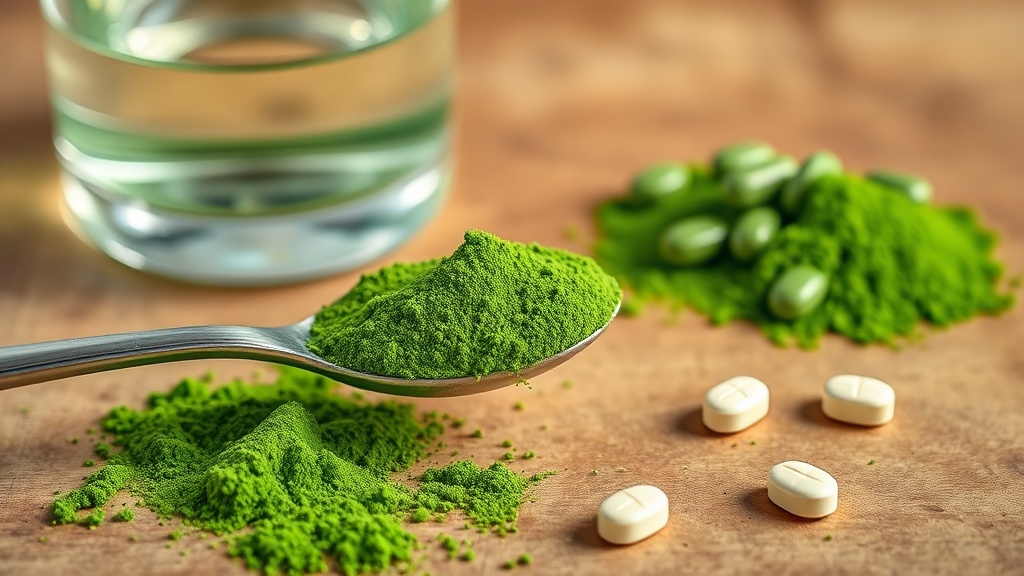
Spirulina is available in several forms: powder, tablets, capsules, and liquid extracts. Bioavailability varies significantly. Powdered spirulina, when mixed with water or food, has moderate bioavailability due to the presence of cell wall polysaccharides that resist digestion. Tablets and capsules, which are compressed or encapsulated powder, may have slightly lower bioavailability due to reduced surface area. However, a study comparing spirulina tablets versus powder found no significant difference in phycocyanin absorption (Karkos et al., 2011, PMID 21466434). Liquid extracts, often alcohol-based, may enhance the release of phycocyanin and other water-soluble compounds, but data are scarce. A novel approach is the use of broken cell wall preparations or enzymatic hydrolysis, which can increase phycocyanin bioavailability by up to 2-fold. Consumers should note that the bioavailability of spirulina's nutrients, particularly vitamin B12, is debated; the B12 in spirulina is predominantly pseudovitamin B12, which is not bioavailable in humans. For optimal absorption, taking spirulina with a source of fat (e.g., a meal containing oil) may improve the uptake of fat-soluble constituents like GLA.
Dosage and Quality Considerations
Typical dosages of spirulina in clinical trials range from 1 to 8 grams per day, divided into two or three doses. A common starting dose is 3 g/day (e.g., 6 tablets of 500 mg each). For specific outcomes, such as lipid-lowering, doses of 4.5 g/day have been used (Mazokopakis et al., 2014, PMID 24666920). The form should be considered: powder can be mixed into smoothies or juice, while tablets offer convenience. Quality is paramount due to contamination risks. Spirulina cultivated in open ponds may accumulate heavy metals (lead, mercury, arsenic) or microcystins from cyanobacterial blooms. Reputable manufacturers test for these contaminants and provide certificates of analysis (COA). Look for products that are certified organic and have been tested for heavy metals and microcystins. The European Food Safety Authority (EFSA) recommends a maximum of 1 µg/g for microcystins. Additionally, spirulina should be sourced from controlled environments (e.g., closed photobioreactors) to minimise contamination. The presence of iodine can be a concern for individuals with thyroid disorders; typical spirulina contains 0.5–5 µg/g iodine.
Drug Interactions and Contraindications
Spirulina may interact with several medications. Its immunomodulatory effects could theoretically reduce the efficacy of immunosuppressants (e.g., cyclosporine, tacrolimus) by stimulating immune activity. Conversely, it may enhance the effects of anticoagulants (e.g., warfarin) due to its vitamin K content, potentially increasing bleeding risk. The mechanism is that vitamin K promotes clotting factor synthesis, counteracting warfarin's action. However, spirulina's vitamin K content is relatively low (about 25 µg per 3 g), so significant interaction is unlikely at typical doses, but caution is advised. Spirulina also has mild hypoglycaemic effects; concurrent use with antidiabetic drugs may require dose adjustment. In vitro studies suggest that phycocyanin inhibits cytochrome P450 enzymes (CYP3A4, CYP2D6), which could alter metabolism of drugs like statins or antidepressants (Sathasivam et al., 2017, PMID 28760430). Contraindications include phenylketonuria (due to phenylalanine content) and autoimmune conditions (e.g., multiple sclerosis, rheumatoid arthritis) where immune stimulation might exacerbate disease. Pregnant and breastfeeding women should consult a healthcare provider due to limited safety data.
Sourcing and Quality Markers
To ensure efficacy and safety, spirulina products should be assayed for key active markers. The primary quality marker is phycocyanin content, typically expressed as a percentage of dry weight. High-quality spirulina contains at least 10–15% phycocyanin. Other markers include total phenolic content (≥10 mg GAE/g) and antioxidant capacity (e.g., ORAC value). Certificates of analysis should confirm absence of heavy metals (lead < 0.5 ppm, arsenic < 1 ppm, mercury < 0.1 ppm) and microcystins (< 1 µg/g). Third-party testing by organisations such as USP or NSF International adds credibility. GMP (Good Manufacturing Practice) certification ensures consistent production standards. Additionally, the source water and cultivation method matter: spirulina from Hawaii or other pristine environments is often preferred. Consumers should avoid products with added fillers or synthetic binders. The colour and odour are also indicators; fresh spirulina has a deep green-blue hue and a mild seaweed smell. Rancidity or off-odours suggest oxidation.
Where to try it. If you want to source what we have described in this article, a standardised Spirulina supplement is the option we point readers to. This site is published by Vitadefence Ltd; we disclose that here.